
What Actually Matters in SOP Software for Food Manufacturing
Most SOP tools were built for office teams documenting software workflows. Food manufacturing is different. You're dealing with raw meat at 4°C, allergen cross-contamination risks, CCP monitoring logs, and cleaning schedules that need to happen at exactly the right time or your next audit goes badly.
HACCP compliance isn't a checkbox. It's a daily operational reality. The SOP software you pick needs to handle that reality, not just let you write pretty documents.
Here's a straight comparison of seven tools that food manufacturing teams actually use.
What Should SOP Software for Food Manufacturing Actually Do?
Good SOP software for food manufacturing must support HACCP documentation, allergen controls, temperature logging, and cleaning verification, not just generic step-by-step instructions.
The minimum bar for food manufacturing is higher than most industries. Your SOPs need to capture critical control points (CCPs), define corrective actions, and create audit trails. A tool that's great for onboarding a warehouse picker might completely fall apart when you need to document a HACCP plan or track sanitation records.
Before you read the tool breakdowns, check that any tool you're considering handles these four things.
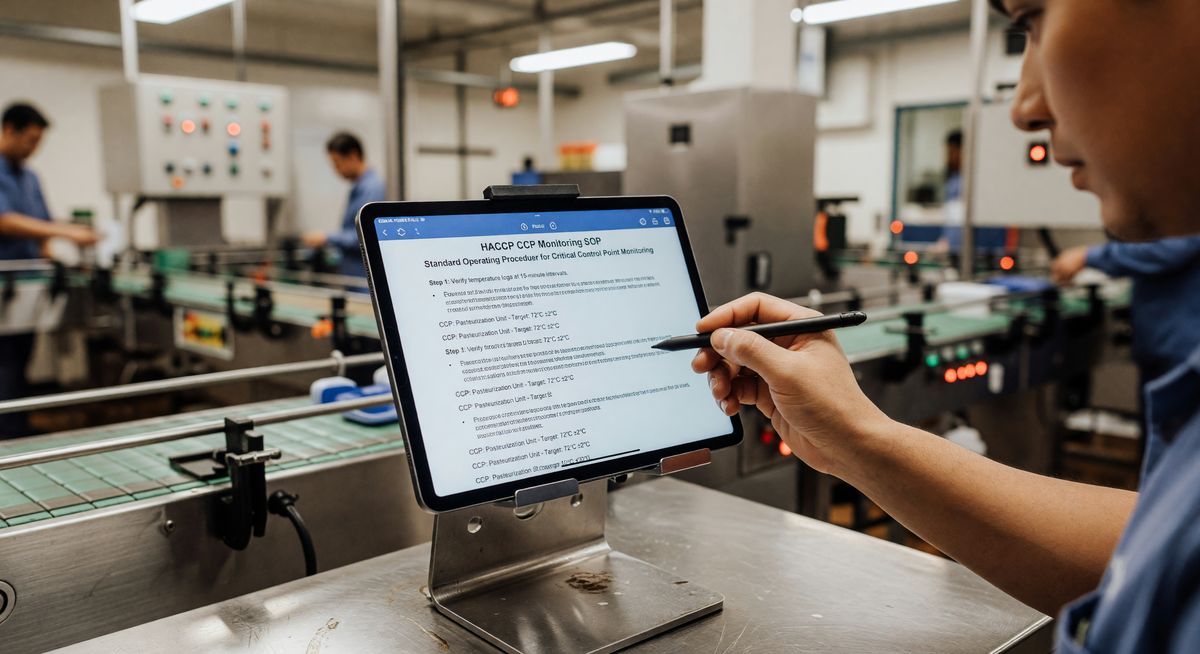
HACCP documentation. Can you build CCP monitoring procedures with defined limits, frequencies, and corrective actions?
Allergen controls. Can you attach allergen information to specific procedures and flag changeover cleaning requirements?
Temperature and time logging. Can workers record actual measurements during a procedure, not just tick "done"?
Audit trails. Does the system log who completed what, when, with a timestamp?
If a tool can't do those four things, cross it off the list.
How Do the 7 Leading SOP Tools Compare for Food Manufacturing?
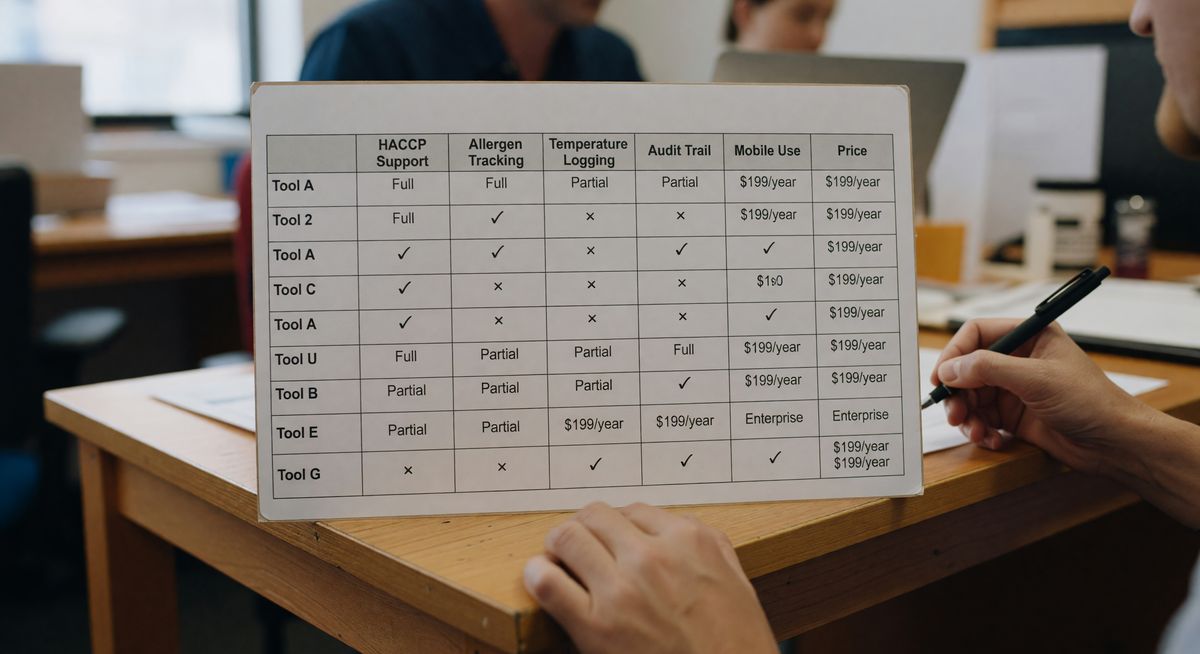
The seven tools most commonly used in food manufacturing SOP programs are BoFlow, SafetyCulture (iAuditor), Dozuki, Whale, Process Street, ComplianceQuest, and Qualio. They're not equal.
BoFlow
BoFlow is built around one idea. Point your phone at a process, record it, and the AI generates a step-by-step SOP with screenshots and instructions automatically. No typing, no formatting, no waiting for someone in the office to get around to writing it up.
For food manufacturing, that matters because your best documentation resource is often a line supervisor who knows exactly how to do a CIP clean or a product changeover but won't sit down and write a Word document. BoFlow removes that friction.
The run sheet checklist feature means workers can complete SOPs as live checklists on the floor, with completion tracked and logged. PDF export and QR code access mean you can print a QR code and stick it on the machine.
Where BoFlow is weaker is in purpose-built HACCP module support. It doesn't have a native HACCP plan builder or dedicated CCP monitoring forms. You'd document your HACCP procedures as SOPs, which works, but it's not the same as a food-safety-specific tool.
Pricing is EUR 4.99 per month for up to 10 team members. There's a free plan for two SOPs. Servers are in Germany, so it's GDPR-compliant. Good fit for smaller food manufacturers or as a documentation layer on top of a dedicated food safety platform.
Learn more about how BoFlow works for manufacturing teams.
SafetyCulture (iAuditor)
SafetyCulture started as an inspection and audit tool. That heritage shows. It's genuinely strong for food safety audits, GMP checklists, and corrective action management.
The template library includes HACCP-specific inspection forms, allergen checklists, and cleaning verification records. You can build temperature log forms where workers enter actual readings, and the system flags readings outside your defined range automatically.
The mobile app is solid. Workers on a production floor can complete checklists, attach photos, and log readings from their phone. Audit trails are detailed and exportable.
Where SafetyCulture gets harder is actual SOP creation. It's an inspection platform that does SOP-adjacent things. Creating detailed, step-by-step work instructions with visual content takes more effort than it should. The pricing also scales up fast once you're beyond a small team.
Best for food manufacturers who need strong audit and inspection capability and already have SOPs documented elsewhere.
Dozuki
Dozuki is a work instruction platform built specifically for manufacturing. That's its whole focus.
The visual work instruction format is excellent. You can build procedures with photos, annotations, safety warnings, and step-by-step instructions that actually look professional on a tablet at a workstation. Workers follow along step by step, and the system captures completion data.
For food manufacturing, Dozuki handles allergen warnings in work instructions well. You can add standardized safety notes and warning types that appear consistently across all relevant procedures. Training records are tracked against specific procedure versions, which matters for FDA and FSMA requirements.
The limitation is that Dozuki isn't designed around HACCP specifically. It's a work instruction system. You can document your HACCP procedures in it, but you won't get built-in CCP monitoring logic or automated corrective action workflows.
Pricing starts around $250 per month for small teams. Expensive for what it is if your primary need is HACCP compliance. Very good if your primary need is visual work instructions with training tracking.
Whale
Whale is a knowledge management and SOP platform. It's well designed and easy to use. The interface is clean, and the browser extension pushes relevant SOPs to employees while they're working.
For office operations in food manufacturing companies, Whale works well. HR procedures, supplier management, finance processes, that kind of thing.
For the production floor? It's not the right tool. Whale doesn't have temperature logging, CCP monitoring forms, or food-safety-specific features. It's not trying to be a food safety platform.
If your quality team needs a tool to document office-based quality management procedures and you want something simple, Whale is fine. But don't expect it to carry your HACCP program.
Process Street
Process Street is a workflow and checklist platform. Teams build procedures as checklists, assign them to people, and track completion. It's popular in food service operations management for things like opening checklists, supplier onboarding, and customer complaint handling.
The conditional logic feature is genuinely useful for HACCP corrective action flows. You can build a temperature check where an out-of-range reading triggers a specific corrective action workflow automatically.
The problem is the documentation format itself. Process Street procedures are text and checklists. There's no strong visual work instruction capability. For training new line workers on a physical process, a text checklist isn't enough.
Pricing is around $100 per month for small teams. Good for management-level food safety procedures and compliance workflows. Not ideal for shop floor work instructions.
ComplianceQuest
ComplianceQuest is an enterprise quality management system (QMS) built on Salesforce. It handles document control, CAPA management, supplier quality, audit management, and training records in one platform.
For food manufacturers operating at scale who need full FDA or SQF compliance management, ComplianceQuest is a serious option. It has purpose-built document control workflows, controlled document versioning, and the audit trail depth that large food manufacturers need for regulatory submissions.
The trade-off is complexity and cost. ComplianceQuest is not a quick-start tool. Implementation takes time and usually requires a consultant. Pricing is enterprise-level, typically $50,000+ per year for a meaningful deployment.
This is the right tool if you're a mid-to-large food manufacturer who needs an integrated QMS and can invest in a proper implementation. It's not right if you need to get SOPs documented next week.
Qualio
Qualio is a cloud-based QMS aimed at food, beverage, and life sciences companies. It sits between the complexity of something like ComplianceQuest and the simplicity of a basic SOP tool.
Document control in Qualio is strong. Controlled documents, review and approval workflows, version history, and employee training acknowledgment all work well out of the box. It's designed with FDA 21 CFR Part 11 and ISO 22000 requirements in mind.
For HACCP documentation, Qualio handles the document management side well. You can store your HACCP plan, CCP monitoring procedures, and corrective action records in a controlled environment. What it doesn't do as well is capture live operational data, actual temperature readings during a monitoring check, for example.
Pricing starts around $300-$500 per month depending on configuration. Good fit for food manufacturers who need document control and compliance management without enterprise-scale complexity.
Which Tool Is Right for Your Food Manufacturing Operation?
The best SOP software for food manufacturing depends on your size, your compliance requirements, and whether you need a full QMS or just better documentation. There's no single right answer.
Here's a practical framework.
Small food manufacturer, fewer than 50 employees, first HACCP program. Start with BoFlow or Process Street to get SOPs documented quickly. Layer SafetyCulture on top for audit and inspection capability. You don't need an enterprise QMS yet.
Mid-size manufacturer, SQF or BRC certification, 50-500 employees. Qualio or Dozuki depending on whether document control or visual work instructions are your bigger pain point. You may end up using both.
Large manufacturer, FDA regulated, multiple sites. ComplianceQuest is worth the investment. The integration between document control, CAPA, supplier management, and training records pays off at scale.
One thing that holds back almost every food manufacturing quality program is the documentation backlog. SOPs exist in someone's head or in a Word document from 2017. Getting them documented accurately and quickly is the first problem to solve. Tools like BoFlow that reduce the time to create a good SOP from hours to minutes address that specific problem well. See how other manufacturing teams use it.
What Features Should You Prioritize for HACCP Compliance?
For HACCP compliance, SOP software must support CCP documentation, corrective action workflows, temperature logging with out-of-range alerts, and timestamped completion records.
Don't get distracted by features you won't use. These are the non-negotiables for a food manufacturing SOP program.
Version control. When a procedure changes, you need to know which version was in use at a given date. This matters in a customer complaint investigation or an FDA audit.
Training records. Workers need to acknowledge that they've read and understood a procedure. That acknowledgment needs to be logged.
Photo capture during execution. Workers should be able to attach a photo when they complete a step, especially for cleaning verification.
Corrective action links. When something is out of spec, the SOP should tell the worker exactly what to do next, and that action should be recorded.
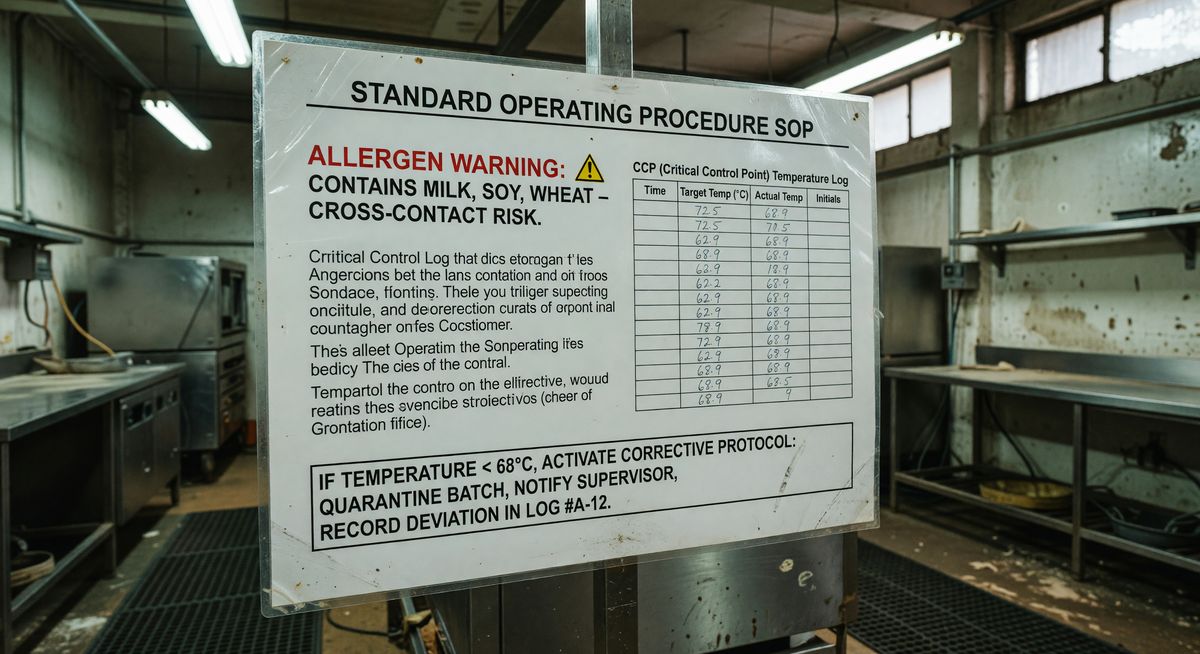
Allergen alerts. Procedures involving allergen-containing ingredients or equipment used for allergen products need clear visual warnings workers can't miss.
FAQ
What is the best SOP software for food manufacturing? The best SOP software for food manufacturing depends on your size and compliance requirements. SafetyCulture is strong for audits and inspections. Qualio handles document control well. BoFlow is the fastest way to create SOPs from physical processes using video capture.
Does SOP software need to be HACCP compliant? SOP software doesn't get "HACCP certified" itself, but it should support HACCP documentation requirements including CCP monitoring records, corrective action logs, and version-controlled procedures. Your HACCP plan needs to be documented and accessible, and the software needs to track who completed what and when.
Can you use Process Street for food safety SOPs? Yes, Process Street works for food safety management procedures and corrective action workflows. It's less suited for shop floor work instructions because it lacks visual work instruction capability. It's better for management-level procedures than production line documentation.
How much does food manufacturing SOP software cost? Costs range widely. BoFlow starts at EUR 4.99 per month. SafetyCulture is roughly $19 per user per month. Dozuki starts around $250 per month. Qualio starts around $300-$500 per month. ComplianceQuest is typically $50,000+ per year for enterprise deployments.
What's the difference between an SOP tool and a QMS for food manufacturing? An SOP tool helps you create, store, and distribute work procedures. A QMS covers the full quality management system including document control, CAPA management, supplier audits, customer complaints, and regulatory submissions. Small manufacturers often start with SOP tools and graduate to a QMS as they scale.
How do I document allergen cleaning procedures as SOPs? Document the allergen cleaning procedure as a step-by-step SOP with visual confirmation photos. Include the allergen involved, the cleaning method, required chemicals and concentrations, contact times, rinse requirements, and a verification step with a sign-off field. Attach an allergen warning to the document header so it's visible before the procedure starts.